Showing posts with label Peninsula Family History. Show all posts

1 March 2012

Muddies get national exposure

Since starting this website a couple of years ago, I’ve learnt lots about the Hoo Peninsula from the growing number of people who get in touch to share their stories and old photos.

I’ve even discovered quite a few ‘new’ distant cousins. Always nice!

Early last year I was contacted by Jill Warby (nee Mortley). Jill was born in Upper Stoke and her family are well known in many local villages, but especially Stoke and Allhallows. But it was only last week that I worked out Jill and I are third cousins, through her mother’s side of the family. We share the same great-great-grandfather, John Watson, who was born in Allhallows in 1833.

As I mentioned the other day, Jill has written a wonderful article about her ‘muddie’ grandfather, Sidney George Mortley. The article has been published in the March edition of The Countryman magazine.

Here’s a photo of Jill with her copy of the magazine. She is pictured with a photo of her late father Ronald Sidney Mortley on the wall behind her.


Well done Jill - it’s really good to see the ‘muddies’ getting some national exposure. They form a fascinating part of our local history. 

If you missed the article I wrote about muddies last week, just click here to take a look.
 

22 February 2012

A farthing’s worth of sweets please!

I mentioned the other day how nice it is being contacted by former, current and future residents! Often living locally, but sometimes living the on other side of the world - it’s fascinating reading the many stories and memories of people with connections to the Hoo Peninsula.

Last week I was contacted by Margaret Hill (nee Ross) who moved away from the area to County Durham in 1968. Margaret lived in Hoo as a girl and has fond memories of living in the area. I was really interested to learn of her connections to some well known local family names, including Miskin, Blackman, Pointer (or Poynter) and Flack.

Margaret told me she is directly related to the Cruttenden family. Her grandfather, William, was founder member of the Hoo Silver Band (pictured below). His wife, Kate, was an officer in the Salvation Army, based at their hall near Crawfords Cottages in Hoo (roughly where the Red Cross Hall is today). Apparently, William and Kate Cruttenden had 9 children.


Margaret got in touch after seeing the ‘Then and Now’ photo series I featured recently, looking at locations along Stoke Road, particularly the old photo of the now demolished Carpet Shop. When Margaret’s grandmother lived in Crawfords Cottages, the shop sold vegetables and sweets - and she has fond memories of crossing the road for a farthing’s worth of sweets.

'High Street', now called Stoke Road, looking west (with Crawfords Cottages to the right).


The same view today.

It was particularly funny to read Margaret’s story of a time when she got cross with her mother, packed a suitcase and, at just 4 years old, left home! She went as far as her aunt’s house, who lived in Abbots Court. Margaret lived along Main Road, near to St. Werburgh Crescent, so I suppose this is quite a distance for someone so young. But she says her mother always knew where to find her!

A view from Abbots Court Road.


Abbots Court, currently under renovation.

Thank you Margaret for getting in touch - I really enjoyed reading your memories of the area.

Would you like to share your stories, memories or old photos of the area? Just get in touch via the contact page.
  

17 January 2012

Who do you think you are?

My father came to stay for several days over the Christmas holiday and he was keen to take another look round the peninsula and the places where our ancestors lived and worked. And maybe do a little research too.

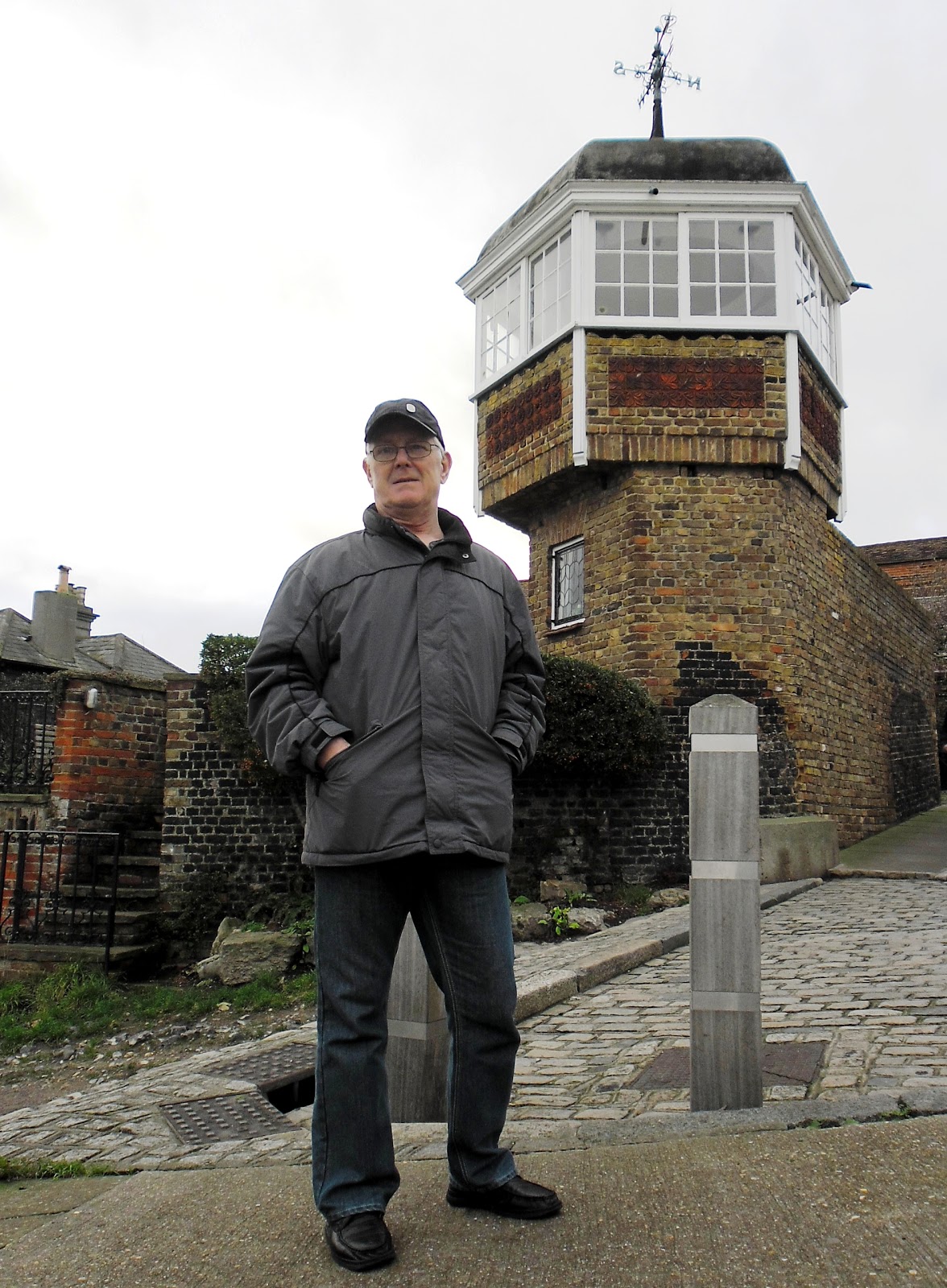
Having a quick look around Upnor High Street

With the BBC’s recent adaptation of Great Expectations, and its desolate scenes of the marshes, spurring our imaginations about how our ancestors might have lived, St. James’ Church in Cooling was the obvious place to start the tour. It’s always good to take in the views from the Church and imagine how different things would have looked in Dickens’ time, before the sea defences changed the landscape so much.

In Lower Stoke we took time to look at the building site that was, until a few years ago, the location of The Ship pub. The pub was run, from 1889 to 1901, by my great great grandfather Henry Spencer - one of my father’s favourite ancestors. I think it might have something to do with their shared experience in the victualling trade.


All the talk and memories of running pubs made my father keen to have his photo taken in front of one - so we opted for The Nags Head (opposite where The Ship once stood). The Nags Head is known for having played host to the famous painter and satirist William Hogarth, back in 1732. Hogarth stayed here, as part of a 5-day tour of Kent with four friends, before reaching the Isle of Grain (where he stayed another night) and then headed on to the Isle of Sheppey.


We then went up the road to Upper Stoke, to pay our respects at the grave of Henry Spencer (he of The Ship), which is in the graveyard of the Church of St. Peter and St. Paul. We also took a look at a gravestone which evokes thoughts about a time of great tragedy in our family’s history.

The ‘Watson children’ gravestone, nestled beneath the tree my father is pictured standing by, soberly lists the names of six children (all of whom would have been my father’s great uncles and aunts had they lived), who died in the space of a few short years between 1871 and 1882. The children were aged between 1 and 19, and there was also a baby just a few weeks old.


We then had a look inside the Church itself, where my father chatted to one of the church volunteers, who asked him his family name. Without prompting, he asked if we were related to an ‘old boy of Stoke’, who went by the nickname of ‘Stumpy’ Watson. My father almost passed out at the mention of ‘Stumpy’, as we have been researching him for a while with little success. We don’t know whether we are definitely connected, but have been trying to find out more about him. He was clearly a well known chap.

I then took a quick photo of my father outside The White Horse pub, also in Upper Stoke. His grandfather ran this pub very briefly from November 1904 to January 1907. The tale behind such a short tenure will have to keep for another time!


The last stop of the day, before heading back home for a cuppa in Hoo, was the Isle of Grain and the Coastal Park. I showed him some of the things improved by the work of volunteers over the past year or so.


Another really useful day out on the peninsula!
 

21 September 2011

Hoo Peninsula Film Project

Over the past few years, I’ve been meeting lots of the peninsula’s longer-standing inhabitants, or ‘peninsula elders’ as I like to call them! And I’ve been recording on camera their stories and memories about living and working here.


Often more than just the typical - and edited - recollections you tend to read in history books, I’ve heard some fascinating tales, some of which have been truly shocking in their detail. Always unique and personal insights into everyday life in this often overlooked corner of Kent and Medway, it’s been a real joy and privilege to have listened to them.

I now have a growing selection of recordings, each of which is being very slowly and carefully edited. When finished I’m planning to donate them to historical archives and any interested local history groups for posterity and, hopefully, for watching by future generations of historians, and residents, seeking to expand their knowledge of local social history.

All those ‘elders’ I’ve had the pleasure to meet so far have been very generous in their willingness to be recorded on film. Not always an easy process, especially when an amateur like me is doing the filming!

I have a whole list of people on my list to get through in the coming months, but it’s always good to hear of anyone else with a few interesting stories to tell.

Just get in touch via the contact page.
 

28 January 2011

Book Research

I’ve been contacted this week by a lady living in Australia, called Margaret Somers. Margaret, who lives near Brisbane, is researching her Hoo Peninsula family history - for a new book that she is hoping to publish.

Margaret’s keen to hear from anyone with connections to the following family names in Cliffe: Smith, Spencer, Goodyer, Harrington, Mills, Parvin and Richards. Her Smith family ancestors settled in Cliffe before 1842.

Margaret is also researching family links in south London, particularly Greenwich and Deptford, where she has a connection to people with the following family names: Allen, Eadle, Gould, Rowe and Warner.

I’m distantly linked to Margaret, through my Great-Great-Grandmother Emma Spencer (nee Smith), who was born in Cliffe, but lived most of her life in Upper Stoke. Margaret is connected to Emma through her father John. The photograph below is thought to be of Emma.


Contact Margaret Somers by clicking here.
  

11 January 2011

Watson or Edwards?

Many family mysteries are best left unsolved, but when the mystery relates to people long since gone, there really shouldn’t be a danger of causing anyone upset. This particular mystery starts some 177 years ago, so I think I’m safe.

Last week I met-up with Mick Edwards (pictured below), who has lived in Hoo all his life. We spent a couple of hours drinking coffee at TAGGS in Hoo village centre, talking about our shared Great-Great-Great-Grandmother Elizabeth Edwards (nee Watson).


Elizabeth Watson married John Edwards in September 1833, when she was 19 years of age. Only months before the marriage, she gave birth in Allhallows to a son, John, who was given the surname Watson - her maiden name. I am a direct descendant of John Watson. Following their wedding, Elizabeth and John Edwards had other children, including a Charles Edwards (John Watson’s brother). Mick is a descendant of Charles.

Both Mick and I have spent many hours trawling through historic records to find out why John Watson was named Watson instead of Edwards, especially when there is plenty of evidence to suggest he was the son of John Edwards.

Does it matter whether I’m really a Watson or an Edwards? Of course not, but it’s quite strange to think of myself as Tony Edwards, if not for an ‘accident’ of birth in 1833.

Without the fantastic resources available at the Medway Archives and Local Studies Centre, none of this would have been known to us.
 

28 October 2010

Fenner Family History

I was recently contacted by Chris Fenner, who runs a family history website. The site includes information about numerous family members that lived on the Hoo Peninsula. Click here to visit the website.

31 August 2010

Peninsula Family History

A new page (Peninsula Family History) has been added to this site, which gives others the opportunity to add their family history research, specifically relating to the Hoo Peninsula. To make a submission, please visit the Contact Page.

Added Today: The Willson family of Stoke, by Mervyn King.

17 June 2010

The Spencer Family, St. Mary Hoo

I was contacted by Barbara Luder last week, who told me that we are distant cousins, connected to each other through the Spencer family.

It was great to add a few more pieces to the jig-saw, as I didn’t know very much about the Spencer’s beyond my Great-Great-Grandfather (Henry Spencer). Although Henry was born in Stoke in 1851, I have now traced the family back to the early-1700s. Many of the Spencer family seem to have lived in St. Mary Hoo, where they stayed until at least the mid-1800s.

Henry Spencer moved from Stoke to Gillingham (Grange Road), working as a Cement Labourer. The family then returned to live in Stoke sometime before 1889, as this is when Henry became the licensee of The Ship Inn in Lower Stoke.

During the time they were living in Gillingham, Henry and his wife Emma had three children. These were May Gertrude (b1879), Maud Lilian (b1881) and Harry (b1888). After returning to Stoke, they had a fourth child , Hubert (b1892). Hubert went on to attend a Teacher Training College and become a School Master. Photographed below (in order of birth): Maud Lilian (my Great-Grandmother), Harry and Hubert.


I look forward to staying in touch with Barbara, my new cousin, and having the chance of doing some more Spencer family research in the coming weeks!
 

9 June 2010

The White Horse (1904 to 1907), Upper Stoke

Long before researching my family history, I always had a love of country pubs. Not just because they are where you find the best quality real ales, but because of the sense of history and community that they normally evoke, where people know each other’s names and everyone is welcomed like a local.

My father owned a country pub for a few years near Canterbury and other relatives have been connected to different pubs over the years. My mother's grandfather ran at least three pubs and his father worked in a rural brewery.

So it came as no surprise to discover a longer history of pubs in the family!

I’ve discovered links on my father’s side to a couple of local pubs. The Ship Inn at Lower Stoke, which I have mentioned before and The White Horse at Upper Stoke. I talked about my links with The White Horse in another post, but I thought I would add some further information about the time my Great-Grandfather was the licensee.


My Great-Grandfather Herbert Watson (pictured above) became the licensee of The White Horse on 11 November 1904. The licence was transferred from a William Bradley.

Herbert was joined by his wife Maud Lilian (nee Spencer) and their three young children, Gladys (b1902), Dorothy (b1904) and Mary (b1906).


Herbert and Maud remained at the pub until 1 January 1907, when the licence was transferred to a James Rayner. I’m told the reason Herbert and Maud left the pub was because of financial difficulties, but precise details are not known. They left with only a tin-box of personal belongings seeking a fresh start in Dover. They went on to have eight more children, between 1909 and 1924. One of whom was my Grandfather!


4 June 2010

The Last Post, The Ship Inn, Lower Stoke

The other day I mentioned the history of The Ship Inn pub (in Lower Stoke), and how my Great-Great-Grandfather (Henry Spencer) ran it between 1889 and 1901.

In those days the pub looked very different to the building that was demolished recently, the original building having been knocked down in the 1950s. So the photograph below is quite literally 'the last post' - the final bit of evidence of a pub having been on this site.


26 May 2010

Short Measures, The Ship Inn, Lower Stoke

I’ve referred to my Great-Great-Grandfather (Henry Spencer) and his time running The Ship Inn at Lower Stoke (from 1889 to 1901) a few times already. I’ve now discovered that, on 25 June 1897, Henry gained a conviction whilst running the pub. If you read carefully, the extract from the 'Register of Licenses - Granted in the North Division of Aylesford Lath' (pictured below), details his conviction for selling measures of gin and whisky below the legal limits.


Henry was ordered by the court to pay 10s (fine) and 9s (costs) for the gin offence and £1 (fine) and 9s (costs) for the whisky offence. Sadly, not the only publican in history to be guilty of this type of offence!

Despite his misdemeanours, Henry continued managing the pub, which was owned by the Lion Brewery, for another four more years.

Apologies for any technical inaccuracies or misrepresentations.
 

20 May 2010

The White Horse, Upper Stoke

A few photographs of the Pub.

Family members gathering outside the The White Horse in Upper Stoke, which I think was probably taken during the 1950s, and then how it looks today.


18 May 2010

The Ship Inn, Lower Stoke

A few photographs of the pub in good times and bad.

Firstly, Herbert Watson, my Great-Grandfather. Pictured standing on the steps of the original pub during the late 1940s or early 1950s, Herbert was in his late 70s when this photograph was taken. He died in 1955.

Secondly, another photograph of Herbert, this time with his daughter and her husband. Herbert's father-in-law, Henry Spencer (my Great-Great-Grandfather), ran The Ship Inn between 1889 and March 1901.

Then a few in a sorry state. Boarded up in 2007. Gutted out in 2009. And in 2010 . . . gone!


What next I wonder?